Monday, August 24, 2015

Here's a kick ass essay I wrote in response to Harriet Jacobs's slave narrative


Subverting Submission: Sexual Agency as a Means to Survival

In her Incidents in the Life of a Slave Girl, Harriet Jacobs subverts the cult of womanhood’s ideals on female sexuality by displaying agency over her own sexuality. In her slave narrative, Jacobs gains a sense of self-affirmation through selecting her own sexual partner, uses her sexual agency as a launch pad from which she seeks broader agency in her life, and weaponizes her sexuality as a “triumph over her tyrant,” Dr. Flint (234).  Jacobs further subverts traditional views on female sexuality as she challenges the founding ideals of her audience’s sexual politics. In asserting that she, a slave woman, has not enjoyed the same luxuries as her readers, she declares sexual innocence a privilege reserved for the free, and demands that she not be governed by the same standards (233, 234). While the cult of womanhood views female sexuality as a mere reaction to husbands’ desires, Jacobs subverts the ideal that women must be reduced to a submissive role. In taking control of who she sleeps with, and what she will gain from the relationship, Jacobs’s sexual agency offers a much different take on the traditional tale of female sexuality.

As a slave woman, Jacobs has little to no agency in life. What she eats, if she eats, where she sleeps, and other things that determine a person’s quality of life, are out of her hands. Her sexuality is no different.  To her horror, Jacobs finds that she does not possess the autonomy to disobey her master, Dr. Flint, even when he starts making sexual advances towards her. “I turned from him with disgust and hatred. But he was my master” (Jacobs 231). In response to this, Jacobs subverts the cult of womanhood’s call for virtuous sexuality, and places herself in the driver’s seat. Rather than shamefully being defiled by one of the “fiends who bears the shape of men” (231), Jacobs declares herself an acting agent in her sexuality.  In engaging in consensual sex with her lover, Mr. Sands, Jacobs is able to achieve a sense of self and spiritual liberation through sexual agency. “It seems less degrading to give one’s self, than to submit to compulsion. There is something akin to freedom in having a lover who has no control over you” (234). It is revolutionary for Jacobs to assert a sense of self found through her sexuality – “freedom” -- in a time when women’s only expected desire is to satiate their husbands. With Mr. Sands, Jacobs is her own focus; she will be as affirmed by this encounter as much as he is.

As Jacobs’s intentions with Mr. Sands become further apparent, however, the reader learns her sexuality is a weapon against her master as much as it is an affirmation of herself.  “I knew nothing would enrage Dr. Flint so much as to know that I favored another; and it was something to triumph over my tyrant even in that small way” (234). Here Jacobs places her sexuality into a much different context. Her relationship with Mr. Sands is not merely about self-affirmation, but a rebellion against the man she is forbidden from disobeying. While the cult of womanhood calls for Jacobs to feel a sense of shame – and she does display that in the text – Jacobs decides that her sexuality is hers to use: if she cannot say “no” to Dr. Flint, she will protect herself by saying “yes” to another. The pro-active approach Jacobs takes with her sexuality declares that she is an acting agent; her position is not merely reactionary, as the cult of womanhood demands. Further still, Jacobs reveals her sexuality as a tool in a much larger plan. Truly calculated in her intentions, she aims to use her sexual agency to gain control over her future. “I thought [Dr. Flint] would revenge himself by selling me, and I was sure my friend, Mr. Sands would buy me. He was a man of more generosity than my master, and I thought my freedom could be obtained from him….of a man who was not my master I could ask to have my children well supported, I felt confident I should obtain this boon” (234).  Beyond an assertion of self, beyond a triumph over tyranny, Jacobs’s sexuality was her meal ticket. In realizing she could use her sexuality to escape Dr. Flint, and conversely, hook Mr. Sands, Jacobs uses sexual agency as a launch pad for gaining more control over her life’s path. Seeking freedom for herself and her children, Jacobs has truly subverted the ideals of female sexuality as responsive and submissive – she is in the driver’s seat now.

While Jacobs does much to subvert the accepted views on female sexuality, it may seem counterproductive that she openly displays feelings of shame and guilt over her sexuality (235). Nevertheless, Jacobs remains keenly aware of her audience: to present all of her subversion without remorse could potentially push readers too far. That is not to say, however, that Jacobs does not maintain subversive through her displays of remorse. In her appeals to readers, Jacobs is directly challenging the hypocrisy that founds these traditional ideals. “Pity me, and pardon me, O virtuous reader! You never knew what it is to be a slave, to be entirely unprotected by law or custom; to have the laws reduce you to the condition of chattel…the slave woman ought not to be judged by the same standards as others” (234). She has already done much to subvert notions on submissive female sexuality, but with this address to readers she asserts that even if these notions were correct, they could not apply to her sexuality. Here Jacobs forces readers to realize the hypocrisy in their ideals. If some women are protected as treasures, while others are sold as chattel, how can all women be expected to adhere to the same values? Jacobs informs her audience that the “purity” that they hold so dear has been “sheltered from childhood” as their “homes are protected by law,” while she “was struggling alone in the powerful grasp of the demon Slavery…” (232). Jacobs incites her readers to take a more critical look at the allowances made for their purity and innocence. With this, she is able to show remorse for her sexuality, while continuing to subvert traditional ideals.

In her slave narrative, Jacobs demonstrates agency over her own sexuality, uses this agency to declare a sense of self, pro-actively defend herself from Dr. Flint, and attempt to gain greater control of her life. In acting as an agent in her own sex life, Jacobs challenges the traditional ideals concerning female sexuality. Within the cult of womanhood, women are expected to be nearly a-sexual. That is, any sexual desires acted on outside of a marriage are condemnable, while within a marriage, all sexual behavior is expected to be in reaction to the husbands’ needs. With this, the sense of liberation Jacobs’s sexuality grants her subverts the popular perception. Moreover, her use of her sexuality as a manipulative tool, to gain things from men, rather than a mere response to their needs, was radical. Further, Jacobs highlights the hypocrisy in shaming slave women for the things they do to survive, while exposing them to the savagery of slavery. In doing so, Jacobs does more to challenge accepted notions of female sexuality, and again casts her sexuality as a weapon.

Tuesday, July 21, 2015

Oasis Health Foods: The Office

I work at Dunder Mifflin Inc.

For the humorless souls who have never experienced The Office, Dunder Mifflin is the fictitious paper company employing the series’ cast – it is the office.

There are an array of quirky relationships and inappropriate behaviors that make the Dunder Mifflin environment so unique. The running theme of hazing/pranking is a pretty visible example of that classic Dunder oddity. Watch a clip here.

I have never been hazed at Oasis* -- the health food store where I work. Nevertheless, from day one, I noticed that the employees and management were of the Dunder Mifflin variety.

One day, walking into the back office of the store, I made sure to introduce myself to both people sitting in the cubicle size room. To greet me, Meredith,* the woman that would be training me on the cash register, says to the other person in the zip-lock bag of a room, “uuuggh, I do not feeling like training today. I just don’t have the patience.”

It is 8:50 a.m. on my first day of work. 

Later that week I made a mistake on the register and Meredith punched me – literally.

Soon after, I was given a new Sensei; Roy* would be training me on the juice bar.  

Roy is an over-six-foot tall White guy. During our first bout of small talk, he asked me if I “had a boyfriend or what.” I answered "no," and his response let me know that he is the I-only-asked-a-question-so-I-could-talk-about-myself type.

“Oh, no. I’m single as f***. Yeah, I used to be fat as f***, so now that I’m not, I just like do whatever I want. And I think you know what I mean by that.”

I told him I understood what he meant and asked him how many ounces of liquid were we supposed to use for a 16 ounce smoothie.

The following Monday, I was across the store, and he asked me, at a speaking-across-the-store octave, if I had “gotten any of that Vitamin D over the weekend.”

What I find most interesting about Roy, though, is not that he’s so blunt. It’s that he is noticeably unfriendly. He’s rude. To the customers, to the other employees, to me. So when he asks me about “Vitamin D,” or says “damn, you should wear those jeans to work” when I come in the store on my off-day, I’m not offended by his frankness, I’m just confused as hell.  

There’s an older black guy, Stanley, who plays The Office’s token grump. What makes him so great is that he is blatantly rude – I mean, there is no wit there. But Stanley is also oddly comfortable talking to his co-workers about his personal life, well-beyond the appropriate 45 seconds that is office small talk. Stanley will tell you that your stupidity disarms him, and then talk to you for three minutes about his upcoming vacation– casually insulting you the whole time. “Ooooo, I can’t wait to get the hell up out of here and get some sun! Lord knows I’m sick of looking at your pasty faces!”

That’s kind of how I felt when Roy said “this may surprise you” – I didn’t ask – “but I listen to a lot of Migos and stuff like that.”

 “Why would that surprise me?” I asked the back of Roy’s shirt as he walked away. Strange how he offers up personal information, without making any attempt to be even remotely sociable.

Within the two-to-three day period I spent underneath Roy, I had seen Wilma*, one of the managers, around the store. We didn’t talk beyond the polite “hi, how are you?” But she seemed nice enough. Normal.

Early one work-morning, she walks up to me and Roy and says “Hi Danielle, I just wanted to let you know that you should park on the employee side of the lot.” I apologized for the oversight, and thanked her. The second she walked away, Roy turns to me and asks: “what a f****** b***h right?”

I foolishly assumed that this was a classic case of the new girl not having the full story. I must have missed something.

Oddly, every day for the rest of my time training, a different co-worker said something along those same lines.

Wilma would say “Good morning, Danielle,” and Meredith would mumble “what is her f***in’ problem?”

What really shocked me, though, was hearing one of the older cashiers talk about Wilma this way. The majority of my co-workers are in their early twenties, so their behavior was odd, but not unfamiliar to me.

Carla*, on the other hand, is 50. Easily.

On my same day-off that Roy strangely suggested I “wear those jeans to work,” Carla was the cashier that rang me up. I made polite small-talk—even if none of my co-workers knew how—and explained to her that I grocery-shopped at Oasis long before I worked there. Somehow she thought informing me of what she studied in undergrad also counted as small talk.

“My degree is in Psychology. The girl that you replaced studied that, too. I asked her if she did a psych work-up on all of us in here.” The eye contact got weird at this point. It was obvious she wanted to say more, so I offered her a chuckle of encouragement. She finished her thought: “I especially wonder what she diagnosed Wilma with. Am I right?”

I regretted my chuckle. Asked her if I could apply my employee discount to everything I bought, or if it was only redeemable with certain items.

I was wrong to assume that I was just the confused new girl. I hadn’t missed anything.
Wilma is Oasis’s “Toby” character.

Toby is one of the only people in The Office that takes his work seriously. On this basis, Michael Scott, the branch manager, fundamentally disagrees with the way that Toby conducts himself in the office. Throughout 9 seasons, the mystery of what the hell Toby ever actually did to Michael remains unsolved. Instead, there are a series of scenes in which Toby does his job, while Michael harasses, and schemes to “justifiably” fire him.

After a month working at Oasis, and bearing witness to the makings of a satirical sit-com, I have resolved to find the ironic humor in everything.

So when Kat,* another 20-something cashier told me that I “really need to take out my nose ring because the managers are like all about professionalism and shit” I discreetly enjoyed the irony of the name tattooed across her neck. I was laughing inside as I looked at the ink covering both of her arms.

She eventually realized the irony.

“Nah, it’s like I got hella tattoos, but I took out my eyebrow ring, though.”

I asked her if she could cover my register. I needed to go on break.


*all names and places have been changed*

Sunday, April 13, 2014

Colored hair doesn’t make you color blind

One night I stood outside the dressing room of one of my Feminist writer inspirations for hours in pouring rain. Soon-to-be-autographed t-shirt in hand, I awaited my turn to get a minute with Lena Dunham. Once she finally emerged, though, all she offered me was a curt glance-over, visibly annoyed with my presentation -- runny mascara, jeans made slick and skin tight with rain, sopping wet shoes. She told me that I was wet, messy, and unwelcomed. And then slammed the door.

This was just a dream.

I am not sure why it is Lena Dunham’s door slamming in my dreams. Perhaps my bitter ex-fan preoccupation with her has her face lurking in my subconscious. In reality, if I were to flinch at the hollowed thud made by another door denying Black women entry, it would more accurately read a general “White Feminism,” and not an isolated “Miss Dunham.”

The revolving door of White Feminism comes to a screeching halt on the attempted entry of Black and Brown women. Soaked to the skin in our messy Black People Problems, the realm of White Feminism, furnished with pristine White carpet, lie on the other side of the dressing room door, removed from our carpet-staining issues.

In recent months, I’ve read fellow Black women bloggers’ posts and tweets about White Feminists making Black women feel unacknowledged, learned about the ugly, racist split Mother of White Feminism Elizabeth Stanton made from the abolitionist movement in 1867, and fallen out of love with Lena Dunham and her non-inclusive feminism and television series. Still, my faith in the movement has kept my skepticism at bay.

However, this Spring Break, I witnessed my peers take a photo that shred every thread of this intricately woven denial.

I, along with around 45 other University of Illinois students, spent Spring Break touring the southern cities pivotal in the Civil Rights Movement. The group was impressively diverse – Black, White and International students, and a handful of LGBTQ folks.

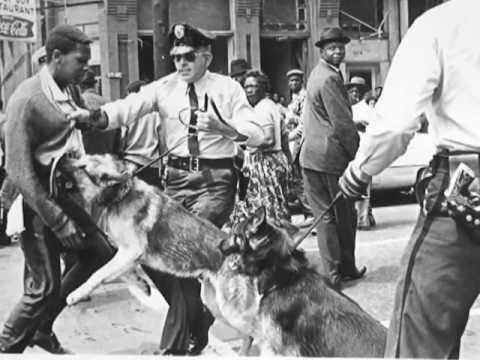
In Alabama, we visited what is now a reserved park space in memory of the epic civil rights demonstration that happened there decades ago. The protest held on these grounds would become one of the internationally famous illustrations of American race relations in the ‘60s.

Photos from this demonstration show White policemen using dogs and fire hoses to deter non-violent, unarmed Black protesters and were seen around the world as a testimony to the surreal reality of Jim Crow. 

For me, standing in this park was chilling. I felt a connection to the protestors whose belief in Black freedom was somehow more powerful than the water pressure from fire hoses that stripped bark from trees, and more fierce than the canine teeth that tore Black flesh from white bone.

On the contrary, some of the White girls on the trip found humor in this sacred space.

Tickled by a statue reenacting one of the hundreds of mini-horror scenes occurring simultaneously during the demonstration, Katie* and Evelyn* opted for a reenactment of their own.  


With grins a mile wide, Katie and Evelyn (right to left) pose as the racist policeman and his dog, while a – Black – boy poses as a demonstrator.

“I’ll be the dog!”

I heard Katie shout this in a tone that would have been appropriate in exclamation of winning a family round of scrabble. Her chipper was a bloody red lipstick stain on a white carpet – jarring and cheap. It rang in my ears each time I looked at one of those girls for the remainder of the trip.

Don’t get me wrong, here, I genuinely enjoyed both Katie and Evelyn. Like Lena Dunham, these girls and their friends are a treat of high intellect complemented by an off-beat spunk. Their unapologetic individuality provided as many laugh-out-loud conversations as it did learning moments for me. Even in the short time of a week-long trip, I feel like I’ve grown from knowing them.

Evelyn, specifically interested in Black and Latino issues, took full responsibility for the offensive nature of this picture, and called it a “learning experience.” Katie handled my confrontation with an impressive amount of grace, too. She was apologetic for offending me and understanding of how the picture was unacceptable.  

My issue isn’t with them -- they are just variables in the larger problematic of White Feminism. I found that here, amongst liberal-minded, pink-haired, socially-conscious, feminist non-conformists, even the “coolest” White girls were painfully out of touch with my reality.

My own confusion indicated all that I had yet to learn from blog posts and tweets critical of White Feminism. I had been thinking:

“Some White women can’t understand Black People Problems, but most White Feminists get it.”

The truth was simple: this movement’s -- made for White women, by White women -- attempt to “get it” is futile at best, and nonexistent per usual.

It would be foolishly dogmatic to assume that the birth of feminism produced no White feminists progressive-minded enough to believe in a sense of true sisterhood with Black and Brown women. Still, while the dressing room door may not slam while “inclusive” feminists hold the knob, more often than not, it appears only to be left ajar for women of color.

The root of the divide is the White feminists’ inability to identify with the complexity of the Black woman’s struggle.

Let’s say The Help’s Miss Hilly was a feminist interested in including Black women in the movement. Had she taken a peek into the life of Minnie, her Black domestic, what she’d have found would've prompted her retreat further into her own pristine White bubble. The smell of alcohol coating the breath of Minnie’s self-hating husband as he slurred justifications for beating her, the sight of a small, glass container housing Minnie’s entire life savings, and the sound of sheets on a twin-sized bed being tousled and yanked by four of Minnie’s own sleeping children would all have felt, to Miss Hilly, like the realities of an alien universe.

To address Black People Problems, Miss Hilly would have to broaden her campaign for more female representation in local politics to account for racial equality now, too. Issues regarding equal pay for men and women would get sticky, as Black women faced relentless job discrimination even within the realm of “women’s jobs.”  And in subversion of patriarchy, Miss Hilly and her feminist friends would now have to attempt to solve the riddle of self-hate and machismo at work when Black men “disciplined” their wives.

Historically, Miss Hilly has been no more capable of understanding Minnie’s Black People Problems than Elizabeth Stanton was willing to stick by abolitionist Frederick Douglass’ side after Black men appeared to be surpassing White women in the crusade against inequality. Whether it’s a matter of misunderstanding or malice, the divide persists.

Katie and Evelyn are not hateful racists – not by a long shot. They simply can’t identify with Black People Problems. If they did, they would find no humor in a park stained with Black blood. 

Turning back into the hellish downpour of my dreams, I can understand why Lena Dunham was unenthused by my presence– no one wants rainwater stains where White carpet was once unblemished. However the issue is, and remains, why I was wet in the first place, while she had no trouble keeping dry. The White Feminist disengages with the messiness of Black People Problems, while simultaneously enjoying the White privilege affording her sisters the privilege of an appearance unblemished by the intersection of dual identities.   


*Katie and Evelyn’s names have been changed

Tuesday, March 18, 2014

The Politics of Casual Sex

With my bottom perched on my front porch ledge, legs dangling, and face warm from an overheating cell phone, I spent a very cliché, High-School-Musical-esque amount of time gossiping with friends about what we thought “the boysss” would be like the summer before we started college.

Do you think they’ll have facial hair – like all of them?
I wonder if college White boys are more open to dating Black girls…
Do you think sex with a college freshman will be any better than with a high school senior?
 I doubt it…

Initially, this curiosity, mirrored by my friends’ shared sense of adventure, sparked the kind of colorful, unproductive dialogue that characterizes summertime, porch ledge Girl Talk.

And then there was a shift in the conversation.

“I’m not gonna sleep around. I don’t want to be seen as 'that slutty freshman.' "

This change of focus agitated me. Beyond this, though, I was perplexed. We were all single, young, attractive little women. Why had the center of our sex talk gone from “I” to “He?”

We had no boyfriends. Certainly no husbands -- what compelled us to compromise? The entire concept of casual sex seemed to be founded on fun-loving and rule-bending. I wanted them to stick with the program.

Outnumbered, I decided, at the very least, I could support my girlfriends’ employing the Power of the Pussy strategy to further their own agendas: gaining respect was the end game.

And then, last week, one of these friends – we’ll call her Jezebel – told me the story of her sexual dissatisfaction. It finally clicked for me. In the juxtaposition of female sexual freedom and male desires, the latter should never be weighted more heavily. In putting our desires on the backburner, young women are allowing men to re-cast us in our own sex lives - placing us where they find us most desirable in their own fantasies.

I’ll let her tell it.

“I’ve spent this whole first semester trying to be The Good Girl. But for what? I’m not The Good Girl. At least before I did what I wanted, and I had fun. Now, I pretend to be The Good Girl so guys will like me. And I still haven’t gotten the attention of the guy I like. And I’m not having sex. Trying to be The Good Girl has completely backfired. Because I’m not the Good Girl.”

If in reaction to this quote you felt the sudden compulsion to text an old flame, twerk in the spirit of liberation, or exclaim “OH SHIT,” you ain’t The Good Girl either, honey.

Those of you who follow me on twitter (@knowmorenoless_) – no, I am not above a transparent Tyler- Perry-style self-promo -- have read my rants on what I think is at the root of The Good Girl obsession:

The Virgin/Whore false dichotomy.*
*False dichotomy is a fallacy that invalidates arguments by presenting two –usually extreme – end points as the only options in a given scenario.*

This is the socially constructed – and thus, inherently in need of analysis and challenge – concept that women’s sexual identities are limited to either Virgins (essentially Good Girls) or Whores.

Like most young women, Jezebel resents the Whore label, and all its connotations; she desires respect. She also knows that there is a male desire for a respectable Good Girl -- and a challenge.

With this, Jezebel strategized: in abstaining from sex, she could position herself at the center of male desire and respect. Nevertheless, as is the case with most dishonest political strategies, Jezebel’s constructed Good Girl image backfired. In tapering her persona to the desires of men, she found herself playing a supporting role in her own sexuality, while the men she sought respect from starred.

She got The Good Girl’s respect. She lost The Whore’s sex life.

Problematically, Jezebel was not The Good Girl, she wanted to “put out.” She, like so many of us, was shrinking her own sexual identity to fit into the confines of the male fantasy.

With all flawed Either/Or arguments, there is a consequence for making the wrong choice. In the case of the Virgin/Whore scenario, “I’ll take ‘Whore’ for 200, Alex” is the quickest way to receive a (one-way) ticket to Sluttyville – the land of unsolicited, public ass slaps, name-calling, leaked nude pictures, and rarely returned phone calls. 

Of course Jezebel didn’t want to be "that slutty freshman." But she also hated being the sexless Good Girl, waiting on a well-behaving man to liberate her.

For the readers who will, again, accuse me of over-analyzing: the Virgin/Whore construct is highly visible in mainstream media:


This meme perfectly illustrates the dichotomy as perpetuated by pop culture – the words are literally Kanye West lyrics. What’s better, I found the meme on Instagram, the social media site.

Like that rapey gym teacher in Mean Girls, pop culture is always there, lying to young women about how limited our options are.


In the Jezebel cases, the fear of being labeled a hoe is – even if temporarily -- stronger than the sense of entitlement we feel to our sexuality.

Admittedly, the argument could be made that Jezebel was actually taking power back, and not relinquishing it: in abstaining from sex, she used the Power of the Pussy as a bargaining tool – only planning to “give it up” to the men who respected her. But do you see how the emphasis here is still on the man?

"He needs to earn it."
versus...
"I really want to have sex with him."

The former phrase presents female sexual consent as a reward for good male behavior, whereas the latter poses it as the result of female desire.

In the casual sex ring, The Good Girl is supposed to present herself as the trophy, which may seem flattering – empowering, even – but note where the power lies here:

If our sexual consent is like a trophy, wouldn’t that prohibit us from enjoying desire? Trophies don’t choose when they want to be won based on personal desire; they reward whoever performs best. Doesn’t this reduce our sexual roles to being reactionary? Think about it: the trophy is indifferent – it doesn’t desire to be claimed any more than it wishes to be left to collect dust; its consent is completely dependent on the behavior of the athletes. So, if women are the trophies, and men are the athletes, doesn’t this mean that we have sex out of congratulatory obligation, and not intrinsic desire?

The Good Girl’s sexuality only operates within the realm of male behavior. There is no space for her to make self-centered sexual decisions because her consent is inseparable from his behavior – whether good or bad. Although it may seem she holds the Power of the Pussy, in truth, HE does.

The Jezebels -- those of us who just don’t think like The Good Girls. The girls uninterested in eluding sex the way trophies tease champions – are casual sex politicians: working to erase the Virgin/Whore boundary, maintain in power, and resist internalizing hateful, ill-informed public opinion. 


Tuesday, February 18, 2014

"Progress:" Twitter culture celebrates Trayvon Martin's birthday, awards Zimmerman celebrity status


The Trayvon Martin case was so publicized that it seemed to become a part of pop culture -- the same way we Keep Up with the Kardashians, we tuned in to CNN for the case updates. It was controversial, provocative, complex, and America ate it up.

It was hard to see through the haze of cheap media buzz that surrounded the trial. Consequently, I was reluctant to speak on the issue when it resurfaced in honor of Trayvon’s recently-passed birthday. The way I was made aware of Trayvon’s birthday was, alone, enough to discourage me from adding to the media buzz. A Trending Topic on Twitter, I saw #HappyBirthdayTrayvon in the same spot on the social media website that #RIPShirleyTemple appeared days later. Was Trayvon a martyr or a pop icon?

Even more inappropriately, Zimmerman’s notoriety has rewarded him with a celebrity status. (See George Zimmerman sightings in tabloid magazines/newsy-gossip sites.) Coverage of the cancelled “George Zimmerman celebrity boxing match” falls under the cheap media buzz umbrella, too.

Via impromptu conversations, I have found that my family and friends draw mirrored conclusions about the case.

I also find these similar conclusions unsatisfactory in their analysis of the tragedy.

We've already juxtaposed George Zimmerman’s malicious cowardice and Trayvon innocence. We know Zimmerman was a blood-thirsty-cop-wannanbee and Trayvon a black-boy-shooting-target. We have examined the reasons Zimmerman should have waited for back up, and what effect Trayvon’s raised hood had on his “martyrdom.” But I think there is something being held back here. To individually label Trayvon “victim,” Zimmerman “evil-doer,” and put a “past tragedy” stamp on this horror story is too easy. We are missing the 3-Dimensional perpetual nature of this injustice: both parties are manifestations of the systematic racism that’s plagued this country for centuries.

Told from Zimmerman’s perspective, SIUE freshman Kenny Coleman’s spoken word piece Dark Knight Vigilantes tells the true story of Trayvon Martin. It is the first accurate analysis of the tragedy that I've heard.


(You may not be able to view this clip on your phone. This is a technical difficulty that reaches beyond my elementary technological capabilities. Please go to the online version of my blog to watch. It's worth it.)

"He was just another impersonation, another abomination, because only my kind can be the Dark Knight Vigilantes - why do you think we kill off all your activists and missionaries?"

To those subscribing to the racist ideology that killed him – Zimmermanism-- Trayvons pose a threat. White fathers fearing the depth of their daughters’ fascination with forbidden fruit, White parents choosing flight when they see their children’s schools “diversifying,” and White conservatives who – behind closed bedroom doors -- always mention Obama’s race in their disapproving rants, are all Zimmermanist thinkers. This wasn’t a White man killing a Black boy. He was, as Kenny called him, a White knight, eliminating the Black threat.

"The color of his skin had my nerves, itching"

Zimmermanism blurs the line between rational -- albeit inherently racist -- protectiveness, and blind hate. Trayvons -- a threat to the Zimmermanist way of life -- must be eliminated. With this, the actions of Zimmermanist neighborhood watchmen become lethal. If it really were just about protection, the sight of “suspicious-looking” Trayvons wouldn’t make Zimmermanists itch. Intruders should scare neighborhood watchmen, not repulse them. In using “itching,” Kenny heightens our senses, making us more keenly aware of what Zimmermanists feel. For us, to “itch” most basically means to possess a compulsion to scratch. With this, Kenny’s words paint images of Zimmermanists with the urge to eradicate their neighborhoods of the Trayvon itch. Additionally, itching is the sensation we feel after finding a bug crawling up our shins; we start to itch all over –our scalps tingling, the stubby hairs on our legs buzzing with electricity- “itch” is associated with a sense of crazed, frantic paranoia.

"As we exchanged, mocking words, and knocking fists, I closed in, I couldn’t win, so I … I responded with self-defense"

Hearing this, I felt Kenny was drawing a profound parallel. He aligned Zimmerman drawing his gun, after realizing he was physically outmatched by Trayvon, with the collective White man's political use of excessive force: systematically oppressing Black people after finding physical attacks to be an ineffective deterrent. Furthermore, Kenny asserts that this institutionalized racism has been justified as self-defense. 

Whenever fists are knocking, a loser inevitably emerges. Once the loser in a fight realizes he is outmatched, he may start to play dirty. Maybe he’ll use a firearm. Maybe he’ll kick his component while he’s down. Maybe he’ll call for some back up, making the fight unfair. 

This is the literal side of the parallel Kenny draws. However, the more insidious side of this scenario materializes when the battle is actually not physical at all.

It is more often the case that Zimmermanists employ politics -- and not direct, physical violence -- in the elimination of the Trayvon threat. In Chicago, Zimmermanists have historically contained the threat to specific sections (“hoods”) of the city. The threat is quarantined: separated from White school districts, unharmful to White children. This quarantine is a last-ditch effort, resulting from the repeated Zimmermanist underestimation of Trayvons. The day they realize our mental and spiritual strength outmatches racist hate, Zimmermanists begin fumbling for their political firearms. Historically, these firearms have been manifested in the instances of massive resistance to passed desegregation and affirmative action laws, White flight that leads to lowered (Black) property values, and we could see Zimmermanist nails pinning the “Whites Only” signs in place above public eateries, bathrooms, and water fountains.

Today, bullet shell casings emblazoned with an indignant “Z” lay at the feet of Jordan Davis’s body.

As abhorrent as this history is, we live in the age of Twitter activism -- an era in which real world tragedies are viewed through a reality TV lens. Consequently, "Zimmerman Spotted" occupies the same tabloid headline space allotted for "Kim K. files for divorce after 72 Days."  Apparently, both are celebrities to Keep Up with.

Thursday, January 30, 2014

Misogynoir: it gets the people going


Am I the only black woman who feels the pressure to compromise my womanhood in celebration of my blackness?
I’ve recently realized being proud, black, and woman, are not identities allowed to co-exist peacefully. In fact, attempting to show all three faces is perpetually met with challenge and discouragement.  
This past Saturday, it was my university’s Kappa Alpha Psi fraternity that discouraged me.

I apologize for the poor quality of this video. But listen closely, the message will still be felt, even if not clearly seen:
Give me brain, bitch, fuck yo’ academics
We sipping, drinking, smoking weed, fucking bitches
This video clip, captured by a friend of mine, features a small portion of the Kappa fraternity's probate. (To my treasured non-blacks readers: probates are the unveiling ceremony held for new fraternity brothers, affectionately welcomed as “neos”).
Other catchphrases, not shown by the clip, ran along similarly derogatory lines. To paraphrase:
You don’t know me, but I bet yo’ bitch do
Is yo’ bitch in good hands?
As a black person observing an event intended to celebrate Black Greek life, I struggled to grasp what I was hearing, seeing, feeling. As a black woman, I feel less than celebrated by the black men on stage calling me, and all the other women watching, “bitch.” When being instructed to perform oral sex and forget my academics, I feel too distracted by my attacked womanhood to celebrate my blackness.
These identities cannot be separated.
With this, my reaction to the probate was as eloquent as the dignified Black men of Kappa Alpa Psi Inc.
“What the fuck?"
Thankfully, one of the Kappas I spoke with, we'll call him Kappa Man, has a more articulate response.
I understand people are gonna take offense to things, but it’s not directly pointed towards them …. I know there are derogatory terms, I know the word “bitch” was used, excuse my language … but it wasn’t used towards anybody specific. Let’s just say it’s being said to the general population.
To minimize these labels as "general"or impersonal, instead of the specified attacks on women that they are, feels like covering a gunshot wound with a Band-Aid.
The only way I have ever seen this done is by those willing to compromise their womanhood in exchange for their blackness. Kappa Man's rationale begs the question: is it possible to love only half of your identity, but still love your whole self? I imagine that this path of half-loving leads to a place riddled with self-hatred.

Admittedly, I understand the compromising black woman. Whether simple-minded or desperate in her compromise, she bears a lightened burden. Because to be proud, black, and woman is a load heavy enough to immobilize.
After all, even for all of the nuance and complexity of this dual identity, we do have a choice.
I could choose to suppress my feminist identity. I could settle for objectification, consoled by the warm embrace of mainstream black community and culture. Conversely, I could choose  to adopt the music, college Greek life, and men of other, less-destructive cultures. I could declare that my female identity trumps my black identity.
However, I am black, and, simultaneously female. I see no just compromise for what is not wrong.
With this, Kappa Man's jazzed-up “it ain’t nothing personal” falls on deaf ears. This justification feels dismissive. Had he been a less articulate Kappa Man, I can imagine that this quote would’ve resembled a vacant rap lyric.
 “Quit bitchin. Hoe, sit yo’ ass down.” ~ Trick Daddy
Appropriately, Kappa Man cites rap as a major source of our current “bitches” and “hoes” climate.
It can be related to rap music. With rap music, there’s a certain established culture and tradition of how you rap. You’re gonna be vulgar, you’re gonna use derogatory terms to get your point across and keep the people entertained, just like our Kappa probate.
“Entertainment” is generally associated with positivity. Meaning, Kappa Man's analysis implies that black masses are excited by the degradation of our women. Or, at the very least, the general consensus is that misogyny is a necessary evil. A small price to pay for entertainment. A part of the (rap) game.
Here, Kappa Man subscribes to the expertise of the one and only, Kanye West:
 It’s provocative. It gets the people going, he tells me. 
He goes on to assure me that it’s not as if these probates are woman-hating fests. Nor is the misogyny they present unique to the Kappa fraternity.
"Is it conscious? Yeah, you could say that. Is it the main point? No. Is our goal to objectify women? No. I can relate this back to rap music, or entertainment in general. Is this to objectify women on purpose, or is it to provide entertainment?"
But if it’s that simple, if the marginalization of women simply gets the people going, and there really is no magical, fairy-dust-enveloped, irreplaceable connection between misogyny and entertainment, then there must be a plethora of others ways to entertain.
These things, can be separated.
Unless….
"Because you’re a freshman, you’ve probably never seen a probate, and you’re shocked, Kappa Man explained to me. But the people … the sophomores, juniors, seniors, they all know what they’re coming to see. I don’t mean to come off as an asshole, but it’s your choice to come and see what you know is going to happen, anyway. I know I’m trying to justify us using the language that we use. And, you’re right. It can be cut out of the show. But traditionally, people want it …."
And just like that, Kappa Man has completely re-casted the characters in this story.
The black woman I have been blindly defending has been frequenting these events voluntarily. She has been metaphorically --I assume-- throwing her panties at the same neos that objectify her.
I wonder who the victim is, who the perpetuator is, and whether these identities can exist simultaneously.
Kappa Man tells me the probate’s theme of sexism isn’t new, and isn’t going anywhere.
"There are traditions at a probate. There’s a certain formation you go on. The brothers are going to be greeted in a certain way; it’s a culture. There’s no changing it."
This tradition is ours to share. Instead of blaming black men for our objectification, or shaming black women for our allowance of it, Kappa Man has me thinking: could a black people, truly in love with our blackness, treat any extension of ourselves with hate? I wonder if we, too, are the black man’s scapegoat for his own self-hatred –our own self-hatred.
Peggy Orenstein, a Jewish feminist, author, and journalist draws a cross-cultural parallel. From her perspective, the objectification of Jewish girls is, indeed, an extension of this self-hate.
“The Jewish American Princess was the repository for my community’s self-hatred, its ambivalence over assimilation—it was Jews turning against their girls as a way to turn against themselves,” she said in her book, CINDERELLA ATE MY DAUGHTER.
Traditions can be reversed, even those deep-rooted in toxic self-hate. But with the halls housing these probates packed with black bodies, filled by screams, cheers, and our embracement of harmful themes, there is little incentive for change.
Like Kappa Man says, it gets the people going.