Jhon
told me that I had pretty hands. Not in these words, because he doesn’t
compliment girls from America with whom he has fallen in love at the
inappropriate depth that is having only spent a couple weeks together, but that
is also his appreciating my face in the context of how our facial features will
be merged and divided on the plane that is our child’s, in this language. He
also didn’t use these words because with his dangling hand, bent loosely at the
wrist and bounding and falling with the effeminate dance of a man that either
enjoys sex with other men, or simply has no use for the gender roles that often
encourage sex with the opposite, he would never compliment a woman so plainly
and he only spoke to me in color. I hadn’t decided if all South American men’s
wrists moved with the same flamboyance that his “tu eres mi princesa” words
carried, or if this was simply Jhon Fredy. Maybe this was the behavior of Colombian
men with skin that is somehow miles deep with the browns of coffee beans but
also impossibly red with the rush of indigenous blood. Either way, the
coexistence of these colors in Jhon’s skin was visible –they lived together,
and well –and I decided that we were the original people.
Sunday, January 15, 2017

June (excerpt)
Context: June is 2
years old and his mom is named Ariel. I refer to her throughout the piece as
the Ghetto Mermaid. I play on thematic metaphors of the sea, sea creatures, and
water throughout the piece.
June and I spent two days together. Most of which was me
running behind him as I watched his pupils go from brown to golden yellow,
alive with the glow of mischief that was his insatiable urge to climb up and
then jump off of things. Born to a mermaid, June was just as at home
underwater, and I became his Octopus Guardian. Some tentacles caught the things
that threatened to shatter as he knocked them off of tables, yanked them from
shelves, others reached out to add a step in the gaps that existed between the
floor and the heights of the counter top, bed, and bathroom sink that he tried
to reach. June longed for home, and this part of the Earth would never be
enough for him. He would place his foot on the lowest rung of one of my bar
stools, grab the spinal leg of the chair, and summon all of the might that he
had gathered in his two years here, to bridge the gap between the chair’s
bottom and its seat. Sometimes he got close, most times I would extend a
tentacle. My limb became a padded spring. It sent June to the height that was
his holy grail: the counter top. Once he made it, he would lean forward and
turn on the faucet. But after a while, the mere running of water wasn’t enough,
and June began a scoot-crawl-fall routine into the sink. He did so with so much
zeal, and so much success, that before assisting his ascend to the counter top,
I would walk around the kitchen island and do the dishes. If he was going to
end up in the sink, it might as well be clean, and so I would sit him next to
me on the counter while I washed. But June was taken to another place with the
sight and sound of running water. The sun coming in through the windows bounced
around until it reached my June, and once they met, we were enveloped in a room
of teal and indigo, as the sun reflected the colors in June’s yellow that had
been hidden from my sight, but caught the attention of the sun with the running
of the tap water. The thinnest beam of light, inconsequential if not for its
brightness, erases the dishes from my vision, and replaces them with a glitter
of rhombuses that I blink and blink and blink away, but are stuck on. Blinking
and blinking and shaking my head, I’m not afraid, but frantic to see what thing
of glitter and translucence this beam of light, thin and blinding, is reflecting
off of. I turn off the faucet, and the apartment darkens, cools. The sun has
shifted in the sky, called away from us and drawn to some other being.
“June, what the hell was that?” he breathes a smile and
reaches for his big toe, turning his foot and showing me its bottom. He must
have felt his return to this home, and away from his mother’s, with the end of
the sink’s running water. I knew he did, because of his timing. As I looked at
his foot, a single rhombus, glitter teal and indigo, was disappearing. I could
see now that a moment before, his foot had been covered in scales and that was
the light source that the sun had bounced off of and blinded me with. The sun
had come for June. I finished the dishes and put him in the sink.
Flesh (excerpt)
I pulled my arm back and felt the
wind give. Frustrated, it became the deep exhale of a woman disrespected for
being a woman for the last time. The wind tries at patience, but with each
hurricane breath the plants that make this building on First and Gregory a
home, become exposed at the root. I feel the joints and bones in my shoulder
twitch as their tissues dissolve and seep from my pores. Liberated, my arm
reaches around my body with the greed of a colonizing vine, until I can hear
with my left ear, the steady pulse of blood in my right elbow. With the release
of murderous tension allowed to bubble and reproduce with each “hoe,” “thot,”
and “bitch,” I free the stretched elastic that my arm has become and stare into
the cavity that its contact with Marcus’s face leaves at the parts that used to
be his eye socket, cheek, and its bone. The right side of his face is still
intact, but ruined by the hollowed look of a body abandoned by its inhabitant,
and returned to organic matter. His left eyebrow is still in place too, and I
feel sad at that. The one-million-hairs lush of his eye’s accessories were what
had made him look so regal. My heart sinks a little, weighted by the guilt of
wasting such a beautiful thing. I decide that this is something that I cannot
wholly justify and use my own exhale to summon the wind’s again. Calmed by my
removal of the pollutant, the wind’s release of breath kicks up loose gravel
and dead leaves, but leaves plants rooted and only gently raises the hairs on
my arm, where it chaffed me before. I decide that the beauty that God reserved
for Marcus’s curly eyelashes, full lips and eyebrows, perfect chinstrap, and
eyes deep brown enough to swim in, won’t be wasted. I fold him up, put him in
the trunk of his truck that is the true scene of his murder, and drive one hour
and forty-five minutes to the place where the wind and I had our first
conversation. Marcus will be fertilizer for my mother’s flowers.
Goodbye, Barack (op/ed)
I, like a lot of people, have tried to outrun our shared
reality, and its sentient complement of impending doom. Prior to the GOP
nomination I enjoyed memes of Donald Trump, complete with his affinity for made
up words, child-like faces made during political debates and in interviews, and
laundry lists of the general then-laughable foolishness of the man I was
familiarized with on NBC’ s Celebrity Apprentice. These memes were hilarious,
but they were also more than that. They made us all feel safe.
Of course Donald
Trump wouldn’t, couldn’t win this election.
And anyone who believed that this was anything more than a
poorly-timed publicity stunt—and I’m still not convinced it wasn’t a social
experiment gone horribly, atrociously, xenophobically wrong—was simply diluted.
After all this was 2016 America. Not
1965 America. Not 1865 America. And we certainly we’re not 1935 Germany. We
were living in the age of political correctness, of veiled racism, of an
anti-black evil that has undergone the radical transformation from Mississippi
tree limbs weighted by the decaying burden of Black bodies, to a body of White
Americans that either knew better, or knew to hide the fact that they still
knew evil. We just weren’t those
people anymore.
And then he got the nomination.
Still, we assured ourselves. Surely, Trump wasn’t a real thing. Yes, he was getting
closer. And yes, it was becoming a little uncomfortably
close, but with each debate, my rising sense of panic was calmed. Even for all
of America’s misogyny, and Hilary Clinton’s admitted sketchiness, there was
simply no fucking way that we would elect a reality star and proud
sexist/racist/xenophobe/homophobe over a career politician. It just wouldn’t
happen.
………and…....then……..he…..won…….?
Still, my denial persisted. I just couldn’t accept it. I
still found myself smirking at news updates, and laughing at the idiocy that
was the White women that, as tweeter Feminista Jones so eloquently put it, “were
willing to sacrifice themselves,” just to secure the status quo that for the
past eight years, had been challenged by a Black man and woman from the South
side of Chicago. But it wasn’t funny. And Obama’s farewell address finally made
that real for me, for all of us.
Watching a Black man that is still fine after eight years
and with some added salt where he was once opaquely peppered, a Black man who
is, indeed, Black and proud after years of being reduced to playing politics, a
Black man who has remained dignified in the face of blatantly anti-black
disrespect from nation and political subordinate, a Black man that is still so Chicago after eight years in
Washington, a Black man that, on the night of January 10th remained
supernaturally graceful, diplomatic, and secure in the face of a successor
whose mere entry into office is an affront to his two terms, watching this man
bid us farewell was as beautiful as it was heartbreaking. And when he tearfully
thanked his wife, best friend, “girl from the South side of Chicago” Michelle,
I cried, too.
********************************************
This winter break home from university, I’ve developed an
NPR habit. And every morning, the airways are saturated with news about our
President-elect—I should note that my fingers hovered over my keyboard’s P here, but while admirable, I find the
#NotMyPresident movement a little juvenile. As painful as it is, Trump is our president. Asserting that he
isn’t, while we are all bound to live and suffer in his America (with the
exclusion of those who truly meant it when they said they would leave given his
election) seems like an underdeveloped attempt at pushback. Still, I am out of
solutions and generally shy away from being too critical of those engaged in
activism at any level. Listening to NPR’s stories of Trump’s apparent and
denied ties with Russia, of the Mexican workers and families who were
devastated by the discontinuation of construction on the Ford plant that
promised thousands of jobs, of the Muslim students on my University campus who now fearfully board
campus transportation after a Trump supporter threatened a Muslim student with
a knife, may only be the beginning in a long line of the live collateral damage
Trump and his cabinet seem determined to leave in the wake of what I hope will
be their only term.
But while the collateral damage of one of America’s most
epic mistakes is yet to be seen, those on the opposite end of this shitshow have
been outted. We love to believe that we live in a world in which the dividing
line between good and evil is thick and impenetrable enough to eliminate the
possibility of a racist grey area. For the last eight years, many of us have
been comforted by the mythical reality that the nice White people with whom we
gossip at the gym, share intimate work space and carpool, those that outwardly
abhor slavery and use of the N-word, are not racist. That push come to shove,
they’ve got our back. We have placated ourselves with the foolish belief that
our White acquaintances, and even friends, are diametrically opposed to those
who defend the confederate flag as “a symbol of Southern pride,” to those who assembled
plastic Obama figurines, lynched, and set them ablaze in 2008, to those who cry
“but Black on Black violence!” in conversations about state sanctioned murder.
But this God-forsaken election proves that these two groups are not necessarily
polarized, distant, or even in conflict with one another. As a matter of fact,
given our President-elect, one is forced to wonder whether they are even two
separate groups at all. Of course, if a nappy-headed Black girl asserts that
White people are racist until proven humane, she’s a “reverse racist.” And yet,
America has elected a transparent White supremacist to the highest office in
the nation…………………………………. we are living in a bizarre time.
The optimist in me combats my cynic’s decision that Trump’s
election all but erases Obama, and the alleged progress in our eight years with
him. But it is a losing battle. It seems pretty common sensical that Obama’s
eight steps forward couldn’t have made any substantial impact, given that they
were so easily succeeded by Trump’s sixteen steps back. So, with a heavy heart,
we say goodbye to Barack Obama, and offer vacant, defeated apologies for our
White co-workers, neighbors, and unfollowed Facebook friends. Once again, you
all have completely fucking let us down.
Goodbye, Barack.
Monday, August 24, 2015
Here's a kick ass essay I wrote in response to Harriet Jacobs's slave narrative
Subverting Submission: Sexual Agency as a Means to Survival
In her Incidents in the Life of a Slave Girl, Harriet
Jacobs subverts the cult of womanhood’s ideals on female sexuality by displaying
agency over her own sexuality. In her slave narrative, Jacobs gains a sense of
self-affirmation through selecting her own sexual partner, uses her sexual
agency as a launch pad from which she seeks broader agency in her life, and
weaponizes her sexuality as a “triumph over her tyrant,” Dr. Flint (234). Jacobs further subverts traditional views on
female sexuality as she challenges the founding ideals of her audience’s sexual
politics. In asserting that she, a slave woman, has not enjoyed the same
luxuries as her readers, she declares sexual innocence a privilege reserved for
the free, and demands that she not be governed by the same standards (233, 234).
While the cult of womanhood views female sexuality as a mere reaction to husbands’
desires, Jacobs subverts the ideal that women must be reduced to a submissive
role. In taking control of who she sleeps with, and what she will gain from the
relationship, Jacobs’s sexual agency offers a much different take on the
traditional tale of female sexuality.
As a slave woman,
Jacobs has little to no agency in life. What she eats, if she eats, where she sleeps, and other things that determine a
person’s quality of life, are out of her hands. Her sexuality is no
different. To her horror, Jacobs finds
that she does not possess the autonomy to disobey her master, Dr. Flint, even
when he starts making sexual advances towards her. “I turned from him with
disgust and hatred. But he was my master” (Jacobs 231). In response to this,
Jacobs subverts the cult of womanhood’s call for virtuous sexuality, and places
herself in the driver’s seat. Rather than shamefully being defiled by one of
the “fiends who bears the shape of men” (231), Jacobs declares herself an
acting agent in her sexuality. In
engaging in consensual sex with her lover, Mr. Sands, Jacobs is able to achieve
a sense of self and spiritual liberation through sexual agency. “It seems less
degrading to give one’s self, than to submit to compulsion. There is something
akin to freedom in having a lover who has no control over you” (234). It is
revolutionary for Jacobs to assert a sense of self found through her sexuality
– “freedom” -- in a time when women’s only expected desire is to satiate their
husbands. With Mr. Sands, Jacobs is her own focus; she will be as affirmed by
this encounter as much as he is.
As Jacobs’s
intentions with Mr. Sands become further apparent, however, the reader learns her
sexuality is a weapon against her master as much as it is an affirmation of
herself. “I knew nothing would enrage Dr.
Flint so much as to know that I favored another; and it was something to
triumph over my tyrant even in that small way” (234). Here Jacobs places her
sexuality into a much different context. Her relationship with Mr. Sands is not
merely about self-affirmation, but a rebellion against the man she is forbidden
from disobeying. While the cult of womanhood calls for Jacobs to feel a sense
of shame – and she does display that in the text – Jacobs decides that her
sexuality is hers to use: if she cannot say “no” to Dr. Flint, she will protect
herself by saying “yes” to another. The pro-active approach Jacobs takes with
her sexuality declares that she is an acting agent; her position is not merely
reactionary, as the cult of womanhood demands. Further still, Jacobs reveals
her sexuality as a tool in a much larger plan. Truly calculated in her
intentions, she aims to use her sexual agency to gain control over her future.
“I thought [Dr. Flint] would revenge himself by selling me, and I was sure my
friend, Mr. Sands would buy me. He was a man of more generosity than my master,
and I thought my freedom could be obtained from him….of a man who was not my
master I could ask to have my children well supported, I felt confident I
should obtain this boon” (234). Beyond
an assertion of self, beyond a triumph over tyranny, Jacobs’s sexuality was her
meal ticket. In realizing she could use her sexuality to escape Dr. Flint, and
conversely, hook Mr. Sands, Jacobs
uses sexual agency as a launch pad for gaining more control over her life’s
path. Seeking freedom for herself and her children, Jacobs has truly subverted
the ideals of female sexuality as responsive and submissive – she is in the
driver’s seat now.
While Jacobs does
much to subvert the accepted views on female sexuality, it may seem
counterproductive that she openly displays feelings of shame and guilt over her
sexuality (235). Nevertheless, Jacobs remains keenly aware of her audience: to
present all of her subversion without remorse could potentially push readers
too far. That is not to say, however, that Jacobs does not maintain subversive
through her displays of remorse. In her appeals to readers, Jacobs is directly
challenging the hypocrisy that founds these traditional ideals. “Pity me, and
pardon me, O virtuous reader! You never knew what it is to be a slave, to be
entirely unprotected by law or custom; to have the laws reduce you to the
condition of chattel…the slave woman ought not to be judged by the same
standards as others” (234). She has already done much to subvert notions on
submissive female sexuality, but with this address to readers she asserts that
even if these notions were correct, they could not apply to her sexuality. Here
Jacobs forces readers to realize the hypocrisy in their ideals. If some women are
protected as treasures, while others are sold as chattel, how can all women be
expected to adhere to the same values? Jacobs informs her audience that the
“purity” that they hold so dear has been “sheltered from childhood” as their
“homes are protected by law,” while she “was struggling alone in the powerful
grasp of the demon Slavery…” (232). Jacobs incites her readers to take a more
critical look at the allowances made for their purity and innocence. With this,
she is able to show remorse for her sexuality, while continuing to subvert
traditional ideals.
In her slave
narrative, Jacobs demonstrates agency over her own sexuality, uses this agency
to declare a sense of self, pro-actively defend herself from Dr. Flint, and attempt
to gain greater control of her life. In acting as an agent in her own sex life,
Jacobs challenges the traditional ideals concerning female sexuality. Within
the cult of womanhood, women are expected to be nearly a-sexual. That is, any
sexual desires acted on outside of a marriage are condemnable, while within a
marriage, all sexual behavior is expected to be in reaction to the husbands’
needs. With this, the sense of liberation Jacobs’s sexuality grants her subverts
the popular perception. Moreover, her use of her sexuality as a manipulative tool,
to gain things from men, rather than a mere response to their needs, was
radical. Further, Jacobs highlights the hypocrisy in shaming slave women for
the things they do to survive, while exposing them to the savagery of slavery.
In doing so, Jacobs does more to challenge accepted notions of female
sexuality, and again casts her sexuality as a weapon.
Tuesday, July 21, 2015
Oasis Health Foods: The Office
I work at Dunder Mifflin Inc.
For the humorless souls who have never experienced The Office, Dunder Mifflin is the fictitious
paper company employing the series’ cast – it is the office.
There are an array of quirky relationships and inappropriate
behaviors that make the Dunder Mifflin environment so unique. The running theme
of hazing/pranking is a pretty visible example of that classic Dunder oddity. Watch a clip here.
I have never been hazed at Oasis* -- the health food store
where I work. Nevertheless, from day one, I noticed that the employees and
management were of the Dunder Mifflin variety.
One day, walking into the back office of the store, I made
sure to introduce myself to both people sitting in the cubicle size room. To
greet me, Meredith,* the woman that would be training me on the cash register,
says to the other person in the zip-lock bag of a room, “uuuggh, I do not
feeling like training today. I just don’t have the patience.”
It is 8:50 a.m. on my first day of work.
Later that week I made a mistake on the register and
Meredith punched me – literally.
Soon after, I was given a new Sensei; Roy* would be training
me on the juice bar.
Roy is an over-six-foot tall White guy. During our first
bout of small talk, he asked me if I “had a boyfriend or what.” I answered "no," and his response let me know that he is the I-only-asked-a-question-so-I-could-talk-about-myself
type.
“Oh, no. I’m single as f***. Yeah, I used to be fat as f***,
so now that I’m not, I just like do whatever I want. And I think you know what
I mean by that.”
I told him I understood what he meant and asked him how many
ounces of liquid were we supposed to use for a 16 ounce smoothie.
The following Monday, I was across the store, and he asked
me, at a speaking-across-the-store octave, if I had “gotten any of that Vitamin
D over the weekend.”
What I find most interesting about Roy, though, is not that
he’s so blunt. It’s that he is noticeably unfriendly. He’s rude. To the
customers, to the other employees, to me. So when he asks me about “Vitamin D,”
or says “damn, you should wear those jeans to work” when I come in the store on
my off-day, I’m not offended by his frankness, I’m just confused as hell.
There’s an older black guy, Stanley, who plays The Office’s token grump. What makes
him so great is that he is blatantly rude
– I mean, there is no wit there. But Stanley is also oddly comfortable talking
to his co-workers about his personal life, well-beyond the appropriate 45
seconds that is office small talk. Stanley will tell you that your stupidity
disarms him, and then talk to you for three minutes about his upcoming
vacation– casually insulting you the whole time. “Ooooo, I can’t wait to get
the hell up out of here and get some sun! Lord knows I’m sick of looking at
your pasty faces!”
That’s kind of how I felt when Roy said “this may surprise
you” – I didn’t ask – “but I listen to a lot of Migos and stuff like that.”
“Why would that
surprise me?” I asked the back of Roy’s shirt as he walked away. Strange how he
offers up personal information, without making any attempt to be even remotely
sociable.
Within the two-to-three day period I spent underneath Roy, I
had seen Wilma*, one of the managers, around the store. We didn’t talk beyond
the polite “hi, how are you?” But she seemed nice enough. Normal.
Early one work-morning, she walks up to me and Roy and says
“Hi Danielle, I just wanted to let you know that you should park on the
employee side of the lot.” I apologized for the oversight, and thanked her. The
second she walked away, Roy turns to me and asks: “what a f****** b***h right?”
I foolishly assumed that this was a classic case of the new
girl not having the full story. I must have missed something.
Oddly, every day for the rest of my time training, a
different co-worker said something along those same lines.
Wilma would say “Good morning, Danielle,” and Meredith would
mumble “what is her f***in’ problem?”
What really shocked me, though, was hearing one of the older
cashiers talk about Wilma this way. The majority of my co-workers are in their
early twenties, so their behavior was odd, but not unfamiliar to me.
Carla*, on the other hand, is 50. Easily.
On my same day-off that Roy strangely suggested I “wear
those jeans to work,” Carla was the cashier that rang me up. I made polite
small-talk—even if none of my co-workers knew how—and explained to her that I
grocery-shopped at Oasis long before I worked there. Somehow she thought
informing me of what she studied in undergrad also counted as small talk.
“My degree is in Psychology. The girl that you replaced studied
that, too. I asked her if she did a psych work-up on all of us in here.” The
eye contact got weird at this point. It was obvious she wanted to say more, so
I offered her a chuckle of encouragement. She finished her thought: “I
especially wonder what she diagnosed Wilma with. Am I right?”
I regretted my chuckle. Asked her if I could apply my
employee discount to everything I bought, or if it was only redeemable with
certain items.
I was wrong to assume that I was just the confused new girl.
I hadn’t missed anything.
Wilma is Oasis’s “Toby” character.
Toby is one of the only people in The Office that takes his work seriously. On this basis, Michael
Scott, the branch manager, fundamentally disagrees with the way that Toby
conducts himself in the office. Throughout 9 seasons, the mystery of what the
hell Toby ever actually did to Michael remains unsolved. Instead, there are a
series of scenes in which Toby does his
job, while Michael harasses, and schemes to “justifiably” fire him.
After a month working at Oasis, and bearing witness to the
makings of a satirical sit-com, I have resolved to find the ironic humor in
everything.
So when Kat,* another 20-something cashier told me that I
“really need to take out my nose ring because the managers are like all about
professionalism and shit” I discreetly enjoyed the irony of the name tattooed across
her neck. I was laughing inside as I looked at the ink covering both of her
arms.
She eventually realized the irony.
“Nah, it’s like I got hella tattoos, but I took out my
eyebrow ring, though.”
I asked her if she could cover my register. I needed to go on break.
*all names and places have been changed*
Sunday, April 13, 2014
Colored hair doesn’t make you color blind
One night I stood outside the dressing room of one of my
Feminist writer inspirations for hours in pouring rain. Soon-to-be-autographed
t-shirt in hand, I awaited my turn to get a minute with Lena Dunham. Once she finally
emerged, though, all she offered me was a curt glance-over, visibly annoyed
with my presentation -- runny mascara, jeans made slick and skin tight with rain,
sopping wet shoes. She told me that I was wet, messy, and unwelcomed. And then
slammed the door.
This was just a dream.
I am not sure why it is Lena Dunham’s door slamming in my
dreams. Perhaps my bitter ex-fan preoccupation with her has her face
lurking in my subconscious. In reality, if I were to flinch at the hollowed thud made by another door denying Black
women entry, it would more accurately read a general “White Feminism,” and not an isolated “Miss Dunham.”
The revolving door of White Feminism comes to a
screeching halt on the attempted entry of Black and Brown women. Soaked to the skin in
our messy Black People Problems, the realm
of White Feminism, furnished with pristine White carpet, lie on the
other side of the dressing room door, removed from our carpet-staining issues.
In recent months, I’ve read fellow Black women bloggers’
posts and tweets about White Feminists making Black women feel unacknowledged, learned
about the ugly, racist split Mother of White Feminism Elizabeth Stanton made from the
abolitionist movement in 1867, and fallen out of love with Lena Dunham and her non-inclusive
feminism and television series. Still, my faith in the movement has kept my skepticism at bay.
However, this Spring Break, I witnessed my peers take a
photo that shred every thread of this intricately woven denial.
I, along with around 45 other University of Illinois
students, spent Spring Break touring the southern cities pivotal in the Civil
Rights Movement. The group was impressively diverse – Black, White and
International students, and a handful of LGBTQ folks.
In Alabama, we visited what is now a reserved park space in
memory of the epic civil rights demonstration that happened there decades ago.
The protest held on these grounds would become one of the internationally
famous illustrations of American race relations in the ‘60s.
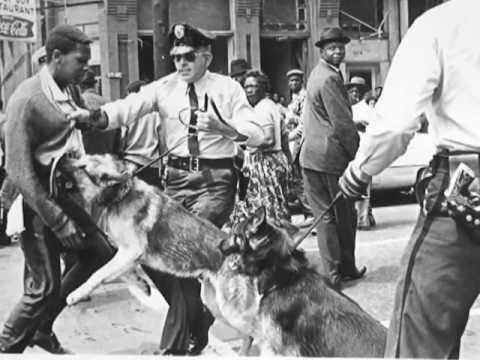 |
| Photos from this demonstration show White policemen using dogs and fire hoses to deter non-violent, unarmed Black protesters and were seen around the world as a testimony to the surreal reality of Jim Crow. |
For me, standing in this park was chilling. I felt a
connection to the protestors whose belief in Black freedom was somehow more
powerful than the water pressure from fire hoses that stripped bark from trees,
and more fierce than the canine teeth that tore Black flesh from white bone.
On the contrary, some of the White girls on the trip found
humor in this sacred space.
Tickled by a statue reenacting one of the hundreds of mini-horror
scenes occurring simultaneously during the demonstration, Katie* and Evelyn* opted
for a reenactment of their own.


With grins a mile wide, Katie and Evelyn (right to left) pose as the racist policeman and his dog, while a – Black – boy poses as a demonstrator.
“I’ll be the dog!”
I heard Katie shout this in a tone that would have been
appropriate in exclamation of winning a family round of scrabble. Her chipper was a bloody red lipstick stain on a white
carpet – jarring and cheap. It rang in my ears each time I looked at one of those girls
for the remainder of the trip.
Don’t get me wrong, here, I genuinely enjoyed both Katie and
Evelyn. Like Lena Dunham, these girls and their friends are a treat of high intellect complemented by an off-beat spunk. Their unapologetic individuality provided as many
laugh-out-loud conversations as it did learning moments for me. Even in the short time
of a week-long trip, I feel like I’ve grown from knowing them.
Evelyn, specifically interested in Black and Latino issues,
took full responsibility for the offensive nature of this picture, and called
it a “learning experience.” Katie handled my confrontation with an impressive
amount of grace, too. She was apologetic for offending me and understanding of
how the picture was unacceptable.
My issue isn’t with them -- they are just variables in the
larger problematic of White Feminism. I found that here, amongst liberal-minded,
pink-haired, socially-conscious, feminist non-conformists, even the “coolest” White
girls were painfully out of touch with my reality.
My own confusion indicated all that I had yet to learn from blog posts and tweets critical of White Feminism. I had been thinking:
“Some White women can’t understand Black
People Problems, but most White Feminists get it.”
The truth was simple: this movement’s
-- made for White women, by White women -- attempt to “get it” is futile at
best, and nonexistent per usual.
It would be foolishly dogmatic to assume that the birth of
feminism produced no White feminists
progressive-minded enough to believe in a sense of true sisterhood with Black and Brown women.
Still, while the dressing room door may not slam while “inclusive”
feminists hold the knob, more often than not, it appears only to be left ajar for women of color.
The root of the divide is the White feminists’ inability to identify with the complexity of
the Black woman’s struggle.
Let’s say The Help’s
Miss Hilly was a feminist interested in including Black women in the movement.
Had she taken a peek into the life of Minnie, her Black domestic, what she’d have found would've prompted her retreat further into her own pristine White
bubble. The smell of alcohol coating the breath of Minnie’s self-hating husband
as he slurred justifications for beating her, the sight of a small, glass
container housing Minnie’s entire life savings, and the sound of sheets on a twin-sized bed being tousled and yanked
by four of Minnie’s own sleeping children
would all have felt, to Miss Hilly, like the realities of an alien universe.
To address Black
People Problems, Miss Hilly would have to broaden her campaign for more female representation in local politics
to account for racial equality now,
too. Issues regarding equal pay for men and women would get sticky, as Black
women faced relentless job discrimination even within the realm of “women’s
jobs.” And in subversion of patriarchy,
Miss Hilly and her feminist friends would now have to attempt to solve the
riddle of self-hate and machismo at work when Black men “disciplined” their wives.
Historically, Miss Hilly has been no more capable of understanding Minnie’s Black People Problems than Elizabeth Stanton was willing to stick by
abolitionist Frederick Douglass’ side after Black men appeared to be surpassing
White women in the crusade against inequality. Whether it’s a matter of
misunderstanding or malice, the divide persists.
Katie and Evelyn are not hateful racists – not by a long
shot. They simply can’t identify with Black
People Problems. If they did, they would find no humor in a park stained with Black blood.
Turning back into the hellish downpour of my dreams, I can
understand why Lena Dunham was unenthused by my presence– no one wants rainwater
stains where White carpet was once unblemished. However the issue is, and remains,
why I was wet in the first place, while she had no trouble keeping dry. The
White Feminist disengages with the messiness of Black People Problems, while simultaneously enjoying the White
privilege affording her sisters the privilege of an appearance unblemished by the intersection of dual identities.
*Katie and Evelyn’s names have been
changed
Subscribe to:
Posts (Atom)